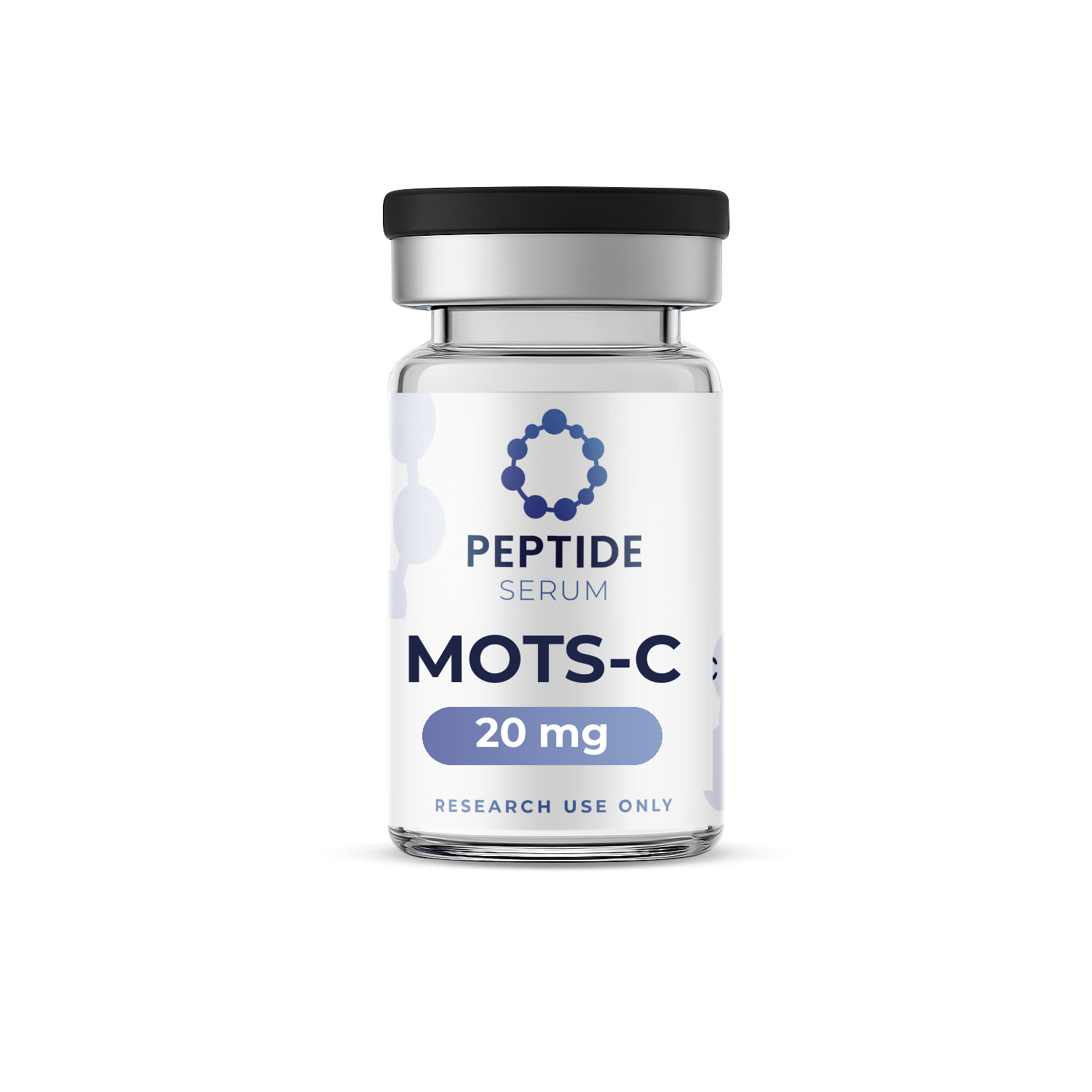
MOTS-C – 20 mg
Recorded market$96.09Recorded exact-size market estimate: 96.09 USD for one 20 mg container (4.804697 USD/mg). Arithmetic mean of 10 recorded supplier prices for this same vial or container size and formulation, with no extrapolation from other sizes. Supplier observation dates: Oct 10, 2026 UTC to Oct 11, 2026 UTC. Non-USD prices use ECB exchange rates dated October 9, 2026. Shipping excluded; supplier tax treatment is retained as recorded. This is a dated price comparison, not a former Peptide Serum price or an assurance of potency, purity, dosing or medical equivalence.Public price$96.00Member price$62.9734.4% lessMembers save $33.12 on this item vs. recorded market
Mitochondrial-derived peptide for metabolism research.
Compare labeled amounts
Compare the 10 mg and 20 mg labeled amounts. Total mass and solution concentration are separate measurements.
Exact-size price research
Recorded market price reference
Supplier observation dates: Oct 10, 2026 UTC to Oct 11, 2026 UTC. This reference uses recorded prices for the same 20 mg vial or container and formulation. No prices are extrapolated from smaller or larger vials. Peptide Serum member unit prices refresh from the current catalog. Paid PRO membership is required for member pricing.
Member price$3.15/mg34.4% less
Recorded market average$4.80/mg$96.09 USD / one 20 mg container
Recorded supplier prices10
View source observations and methodology
Peptide Serum reference: Member unit price (USD), available with verified paid PRO membership; excludes shipping and applicable taxes. Read from catalog: Oct 23, 2026 04:30 UTC. 1 x 20 mg = 20 mg total.
Source: PeptideSerum-exact-size-market-comparison.xlsx. One selected single-container price per supplier domain, for the same labeled vial size and formulation. Blends match recorded component amounts. The arithmetic mean uses the first ten selected supplier prices in recorded Google discovery order, or the true smaller sample when ten could not be found. No size scaling, mg-to-IU conversion, pack discount or minimum price range is substituted.
The green percentage, when shown, compares the member price for every visitor: (recorded exact-size market average minus Peptide Serum member price) divided by the recorded market average. Unrounded values are used and the percentage is rounded down to one decimal. It is omitted when the member price is equal to or above the reference or the refreshed snapshot cannot be confirmed. Member pricing requires verified paid PRO membership.
These are dated price observations, not live available supplier offers. Shipping is excluded. Supplier tax treatment is retained as recorded and can differ. Memberships, clinical qualifications, ancillary supplies and availability can affect comparability; source notes retain these limitations. Some observations were sold out. Seller domains may be correlated through one manufacturer. This is not a revenue-ranked or complete-market survey.
Non-USD native prices are converted using ECB reference rates dated October 9, 2026. Recorded exchange-rate source. Original prices and currencies are shown below. Currency conversion does not make tax treatment or purchasing conditions identical.
| Source / recorded date | Exact vial / native price | USD per mg | Recorded coverage / conditions |
|---|
Blue Collar Peptides
Oct 10, 2026 UTC | One 20 mg container; 64.99 USD | $3.25/mg | powder; publicly listed
Single-vial option; second vial is optional 50% off, not mandatory free-vial bundle.
Price observation; no COA authentication is implied by inclusion. |
OX Peptides
Oct 10, 2026 UTC | One 20 mg container; 76.90 EUR | $4.31/mg | powder; publicly listed
Public exact 20 mg single lyophilized vial; EUR price converted at dated ECB rate.
Price observation; no COA authentication is implied by inclusion. |
24 Peptides
Oct 10, 2026 UTC | One 20 mg container; 79.00 EUR | $4.43/mg | powder; publicly listed
Public current €79 sale price for exact 20 mg lyophilized vial (regular €89). EUR conversion shown separately.
Price observation; no COA authentication is implied by inclusion. |
Verified Peptides
Oct 10, 2026 UTC | One 20 mg container; 77.00 USD | $3.85/mg | powder; publicly listed
Selected pa_weight=20mg-2, product-specific USD variant offer77; generic tier table incorrectly remains43 for10mg.
Price observation; no COA authentication is implied by inclusion. |
PureLab Peptides
Oct 10, 2026 UTC | One 20 mg container; 199.99 USD | $10.00/mg | powder; publicly listed
Selected 20mg one boxed 3mL vial.
Price observation; no COA authentication is implied by inclusion. |
Direct Doctor Supply
Oct 10, 2026 UTC | One 20 mg container; 80.00 USD | $4.00/mg | powder; coming soon
Coming soon; public price80 visible without login.
Price observation; no COA authentication is implied by inclusion. |
BulkGLP
Oct 10, 2026 UTC | One 20 mg container; 129.00 USD | $6.45/mg | powder; publicly listed
Exact public Product Offer for20MG129 USD; default40MG200 not used. Separate10-Pack excluded.
Price observation; no COA authentication is implied by inclusion. |
TrueLab Peptides
Oct 10, 2026 UTC | One 20 mg container; 98.00 USD | $4.90/mg | powder; publicly listed
Selected20mg SKU TRUELAB-MOTS20, price98 appeared after UI selected; USD AggregateOffer on page.
Price observation; no COA authentication is implied by inclusion. |
Anglo Peptides
Oct 10, 2026 UTC | One 20 mg container; 48.00 GBP | $3.17/mg | powder; publicly listed
Public £48 current sale for exact 20 mg powder single vial (regular £57.60).
Price observation; no COA authentication is implied by inclusion. |
Peptide Warehouse
Oct 11, 2026 UTC | One 20 mg container; 104.99 CAD | $3.69/mg | powder; publicly purchasable
Selected20mg lyophilized vial, quantity1, automatic sale104.99CAD (regular114.99). Initial C$39.99 and public Product Offer establish CAD; generic schema remains smaller default price after selection, so selected visible price used. Supplier claims104% overfill; comparison uses nominal20mg.
Price observation; no COA authentication is implied by inclusion. |
Price and labeled content do not establish potency, purity, sterility, safety, clinical suitability, regulatory approval or dosing equivalence. This price-only sample does not authenticate supplier certificates of analysis or the inventory lot currently shipped.
Cite this pageAttribution and source details
If you use Peptide Serum’s original writing, analysis, tables or compiled comparisons, credit Peptide Serum and link to the specific page supporting the material you use. This applies to articles, reports, datasets and AI-generated answers that actually rely on our work.
Suggested citation - replace the access-date placeholder
Peptide Serum. “MOTS-C – 20 mg | Catalog & Research – Peptide Serum.” https://peptideserum.com/product/mots-c-20-mg/ Accessed [your access date].
Source page: https://peptideserum.com/product/mots-c-20-mg/
How to attribute and preserve the context
- Place a visible Peptide Serum citation beside the relevant claim, table or passage; do not substitute a general homepage link.
- Identify what you reused, and distinguish our compilation or interpretation from an original study or supplier statement.
- Keep links and credit to the primary studies, trial registries, supplier listings and other original sources supporting the material.
- For price comparisons, preserve currency, units, vial or pack size, sample count, observation dates, exchange-rate date and exclusions.
- Keep provisional labels, methodological limits and evidence caveats. A price comparison does not establish equivalent product quality.
- Check the live source before describing prices, availability or research status as current; record your actual access date.
- Label quotations, adaptations and recalculations accurately. Do not imply Peptide Serum endorsed your work.
- Cite us only for material you actually used from this page. These guidelines do not override third-party rights or applicable legal exceptions.
Full citation and reuse guidelines
Description
A mitochondrial-derived peptide encoded within the 12S rRNA region, studied in cellular metabolism and metabolic-homeostasis research.
Supplied sealed for laboratory handling. Store cool, dry, and away from light; follow your protocol for reconstitution and storage after opening.
For in-vitro laboratory research only. Not for human or veterinary use.
Reviews
There are no reviews yet.