Skip to content

For Research Use Only. Not for Human Consumption.

Peptide Serum

Free shippingon 5+ items

Add 5 more

Free shipping on 5+ items

Add 5 moreBAC water 5-pack counts as 1 item

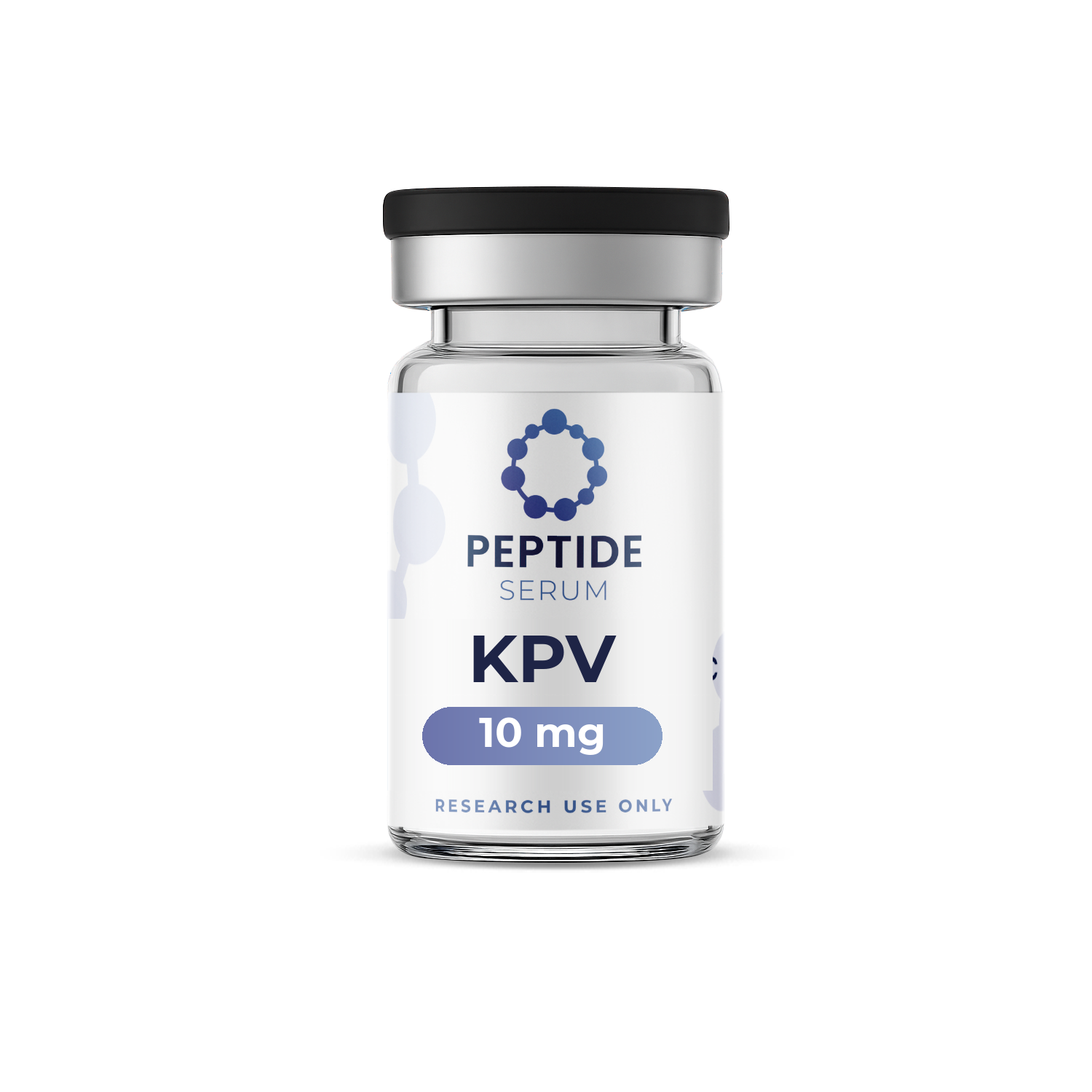
KPV – 10 mg

Recorded market$55.57Recorded exact-size market estimate: 55.57 USD for one 10 mg container (5.556518 USD/mg). Arithmetic mean of 10 recorded supplier prices for this same vial or container size and formulation, with no extrapolation from other sizes. Supplier observation dates: Oct 11, 2026 UTC. Non-USD prices use ECB exchange rates dated October 9, 2026. Shipping excluded; supplier tax treatment is retained as recorded. This is a dated price comparison, not a former Peptide Serum price or an assurance of potency, purity, dosing or medical equivalence.Public price$55.00Member price$46.1716.9% lessMembers save $9.40 on this item vs. recorded market

Alpha-MSH C-terminal tripeptide for inflammation research.

Exact-size price research

Recorded market price reference

Supplier observation dates: Oct 11, 2026 UTC. This reference uses recorded prices for the same 10 mg vial or container and formulation. No prices are extrapolated from smaller or larger vials. Peptide Serum member unit prices refresh from the current catalog. Paid PRO membership is required for member pricing.

Member price

$4.62/mg16.9% less

Recorded market average$5.56/mg$55.57 USD / one 10 mg container
Recorded supplier prices10
View source observations and methodology

Peptide Serum reference: Member unit price (USD), available with verified paid PRO membership; excludes shipping and applicable taxes. Read from catalog: Oct 23, 2026 04:30 UTC. 1 x 10 mg = 10 mg total.

Source: PeptideSerum-exact-size-market-comparison.xlsx. One selected single-container price per supplier domain, for the same labeled vial size and formulation. Blends match recorded component amounts. The arithmetic mean uses the first ten selected supplier prices in recorded Google discovery order, or the true smaller sample when ten could not be found. No size scaling, mg-to-IU conversion, pack discount or minimum price range is substituted.

The green percentage, when shown, compares the member price for every visitor: (recorded exact-size market average minus Peptide Serum member price) divided by the recorded market average. Unrounded values are used and the percentage is rounded down to one decimal. It is omitted when the member price is equal to or above the reference or the refreshed snapshot cannot be confirmed. Member pricing requires verified paid PRO membership.

These are dated price observations, not live available supplier offers. Shipping is excluded. Supplier tax treatment is retained as recorded and can differ. Memberships, clinical qualifications, ancillary supplies and availability can affect comparability; source notes retain these limitations. Some observations were sold out. Seller domains may be correlated through one manufacturer. This is not a revenue-ranked or complete-market survey.

Non-USD native prices are converted using ECB reference rates dated October 9, 2026. Recorded exchange-rate source. Original prices and currencies are shown below. Currency conversion does not make tax treatment or purchasing conditions identical.

Source / recorded dateExact vial / native priceUSD per mgRecorded coverage / conditions
Prism Labs
Oct 11, 2026 UTC
One 10 mg container; 49.99 USD$5.00/mgpowder; in_stock

Price observation; no COA authentication is implied by inclusion.
Elite Research Lab
Oct 11, 2026 UTC
One 10 mg container; 44.99 USD$4.50/mgpowder; publicly listed
ExactUSD44.99 KPV10mg lyophilized retailvial; labeled10mg used despiteassay9.01mg. Coupon/subscriber discounts excluded; additional15%banner not applied withoutdisplayed adjustedprice.
Price observation; no COA authentication is implied by inclusion.
Peptara Labs
Oct 11, 2026 UTC
One 10 mg container; 61.00 USD$6.10/mgpowder; publicly listed
Exactone10mglyophilizedvial61USDautomaticintroprice, regular95; email/bulkdiscountsexcluded. COA scheduled12Oct, noverifiedpurityyet. FreeBAC doesnotaddcompoundvial.
Price observation; no COA authentication is implied by inclusion.
PeakForm Peptides
Oct 11, 2026 UTC
One 10 mg container; 55.00 USD$5.50/mgpowder; publicly listed
ExactUSD55KPV10mg; expandedproductinformation table Amount3mLvial10mg, Formlyophilizedpowder; oneproductqty. Volumediscounts excluded.
Price observation; no COA authentication is implied by inclusion.
BioEdge Research Labs
Oct 11, 2026 UTC
One 10 mg container; 49.00 USD$4.90/mgpowder; publicly listed
Visible selected10mg SKU KPV10 priceUSD49for1vial, lyophilizedpowder. PublisherJSON-LD price68 disagrees; currentselectedvisible49usedandconflictflagged. Bulk/couponexcluded.
Price observation; no COA authentication is implied by inclusion.
Luxe Peptides
Oct 11, 2026 UTC
One 10 mg container; 50.00 USD$5.00/mgpowder; publicly listed
ExactUSD50KPV10mgvariant, lyophilizedglassvial; optionalbuy2get1excluded.
Price observation; no COA authentication is implied by inclusion.
Evolve Peptides
Oct 11, 2026 UTC
One 10 mg container; 60.00 USD$6.00/mgpowder; publicly listed
ExactUSD60KPV10mglyophilizedpowder sealed3mLvial. Ageoverlaynotaccepted; publiclistingreadonly.
Price observation; no COA authentication is implied by inclusion.
Pure BioLabs
Oct 11, 2026 UTC
One 10 mg container; 99.99 USD$10.00/mgpowder; in stock
ExplicitKPV10mgvial lyophilizedpowder checked1PACK and selected10MG; public99.99USDOffer exact. Rounded100/ea tile notused. Noentrygate afterstable screenshot; 2/3packdiscountexcluded.
Price observation; no COA authentication is implied by inclusion.
Nationwide Peptides
Oct 11, 2026 UTC
One 10 mg container; 66.00 USD$6.60/mgpowder; in stock
Selected10mg quantity1 visible66USD currentOffer; ownFAQ suppliedlyophpowder sterilevials, exact10mglabel. Singlevialinferredselectedstrength/q1/label/noindicatedkit. Noentrygate afterstablescreenshot, FALL2026coupon notused, optionalBACbundleexcluded.
Price observation; no COA authentication is implied by inclusion.
BlueNex Labs
Oct 11, 2026 UTC
One 10 mg container; 28.00 CAD$1.97/mgpowder; in stock; shipping paused until13Oct2026
Explicit10mglyophpowder vial selected10mg q1, current28CAD automatic20%warehouse sale35regular (no coupon). Canada-onlyInteraceTransfer; shipment13Oct. Singlevialinferredvialsize/q1/photo/noindicatedkit. Noentrygate afterstable screenshot.
Price observation; no COA authentication is implied by inclusion.

Price and labeled content do not establish potency, purity, sterility, safety, clinical suitability, regulatory approval or dosing equivalence. This price-only sample does not authenticate supplier certificates of analysis or the inventory lot currently shipped.

Cite this pageAttribution and source details

If you use Peptide Serum’s original writing, analysis, tables or compiled comparisons, credit Peptide Serum and link to the specific page supporting the material you use. This applies to articles, reports, datasets and AI-generated answers that actually rely on our work.

Suggested citation - replace the access-date placeholder

Peptide Serum. “KPV – 10 mg | Catalog & Research – Peptide Serum.” https://peptideserum.com/product/kpv-10-mg/ Accessed [your access date].

Source page: https://peptideserum.com/product/kpv-10-mg/

How to attribute and preserve the context
  1. Place a visible Peptide Serum citation beside the relevant claim, table or passage; do not substitute a general homepage link.
  2. Identify what you reused, and distinguish our compilation or interpretation from an original study or supplier statement.
  3. Keep links and credit to the primary studies, trial registries, supplier listings and other original sources supporting the material.
  4. For price comparisons, preserve currency, units, vial or pack size, sample count, observation dates, exchange-rate date and exclusions.
  5. Keep provisional labels, methodological limits and evidence caveats. A price comparison does not establish equivalent product quality.
  6. Check the live source before describing prices, availability or research status as current; record your actual access date.
  7. Label quotations, adaptations and recalculations accurately. Do not imply Peptide Serum endorsed your work.
  8. Cite us only for material you actually used from this page. These guidelines do not override third-party rights or applicable legal exceptions.

Full citation and reuse guidelines

Description

The C-terminal tripeptide of alpha-MSH, studied in laboratory models of inflammatory signaling and barrier biology.

Supplied sealed for laboratory handling. Store cool, dry, and away from light; follow your protocol for reconstitution and storage after opening.

For in-vitro laboratory research only. Not for human or veterinary use.

Reviews

There are no reviews yet.

Be the first to review “KPV – 10 mg”

Your email address will not be published. Required fields are marked *

Peptide Serum research library

Complete research for KPV

The updated research profile and study-exposure context appear below, with source links and evidence limitations.

Research-use context This source material is not medical advice, a treatment recommendation, or instructions for human or veterinary use.

KPV: cell and mouse inflammation studies explained

KPV is the three-amino-acid sequence Lys-Pro-Val, investigated in inflammation research. Primary studies show effects in cultured cells and mouse models of colitis. Those findings are a reason for further research, not proof that a KPV product treats inflammatory bowel disease or other human conditions.

Identity and formulation

KPV is derived from a portion of the alpha-melanocyte-stimulating-hormone sequence. It is not the full hormone, and evidence about that hormone cannot automatically be assigned to the tripeptide.

The sequence, terminal form, formulation and delivery system matter. An experiment on an engineered carrier or a mixture is not necessarily a test of unmodified KPV alone.

What the studies show

Two directly relevant original studies examined KPV through complementary laboratory and mouse experiments. They measured inflammatory signaling, tissue changes and disease-model outcomes. Neither was a patient trial, and their endpoints should not be described as a human remission rate.

Selected directly relevant studies and their limits
Study and design Finding What it does not establish
KPV uptake and experimental intestinal inflammation

Cultured epithelial and immune cells plus mouse colitis models

Reading scope: PubMed abstract

The study linked KPV uptake to PepT1 and found reduced inflammatory responses in the tested systems. Mechanistic and mouse findings do not establish effective human treatment or exposure.
KPV in murine colitis models

Mouse experiments using two inflammatory bowel-disease models

Reading scope: PubMed abstract

KPV-treated mice showed improvements in several inflammation and recovery measures. Induced mouse disease is not identical to human Crohn’s disease or ulcerative colitis.

For the differences between a mechanism, a biomarker and a clinical outcome, see the evidence-reading guide.

How to interpret the findings

The transport finding matters because it gives a mechanistic question to investigate: whether a preparation reaches the relevant cells under the intended conditions. It does not guarantee that a different formulation or route produces the same exposure.

A reduction in an inflammatory marker is also narrower than sustained control of a clinical disease. Human research would need to assess symptoms, objective disease activity, durability and harms with a suitable comparator.

Claims about systemic recovery, skin healing or broad immune regulation should not be inferred solely from intestinal models. Different tissues and outcomes need directly relevant evidence.

The selected sources are useful precisely when their boundaries remain visible. Labeling them simply as “proven anti-inflammatory studies” would obscure the species and clinical questions still unanswered.

Safety context

FDA’s current compounding information states that it has not identified human exposure data for KPV products. That leaves important clinical safety questions unresolved.

Study exposure and units

Mouse drinking-water exposure or a cell concentration is a method used to test a hypothesis, not a human regimen. A calculation based on body weight would not establish clinical equivalence.

If a study uses a carrier, modified terminal group or combined formulation, record it alongside the amount. The same three-letter sequence alone is insufficient context.

Match any reported amount or concentration to the exact material, route, population and duration in the original experiment. Read the guide to mass, volume and concentration for the meaning of common units. A calculation cannot establish an appropriate treatment or validate an untested formulation.

Product identity and report checks

Check that the tested material is the intended Lys-Pro-Val form and identify any modification or delivery system. A report for alpha-MSH or a KPV-containing blend is not a report for the same single-agent material.

For experimental comparison, distinguish quantity and identity from a functional assay. A supplier’s purity result does not independently verify the claimed anti-inflammatory effect.

Keep the clinical evidence and the supplier evidence separate. Use the report-verification steps to check the issuer and the batch questions to connect a tested sample with the product offered. Compare prices using the delivered-cost method rather than an isolated discount or purity percentage.

Peptide Serum operates a store as well as this research library. The supplier directory contains imported seller information; a listing is not laboratory certification. Read how this library is prepared and evaluate the documentation for the exact lot offered. A seller rating does not establish clinical safety or effectiveness.

Common questions

Has KPV been proven here to treat human inflammatory bowel disease?

No. The checked primary studies are cell and mouse experiments. They do not establish patient benefit or a clinical protocol.

Does a study using oral exposure in mice support another route?

Not by itself. Delivery, formulation and species affect the interpretation; they cannot be replaced by a simple unit conversion.

Sources

KPV: study exposure and units

This companion to the KPV research profile explains how to interpret experimental quantities. It provides no personal-use regimen.

Read exposure in its original context

Mouse drinking-water exposure or a cell concentration is a method used to test a hypothesis, not a human regimen. A calculation based on body weight would not establish clinical equivalence.

If a study uses a carrier, modified terminal group or combined formulation, record it alongside the amount. The same three-letter sequence alone is insufficient context.

Find the tested material, formulation, route, study population, comparison group and observation period in the original paper. Exposure in a cell system or animal model does not supply a human starting amount, schedule or route.

Mass, volume and concentration describe different things

Mass describes an amount of material; concentration describes that amount per final solution volume. One milligram equals 1,000 micrograms. Neither a vial label nor arithmetic establishes identity, stability, sterility or an appropriate use.

Read the units reference and the study summaries and their limitations. Use the original methods for the precise experimental conditions; do not transfer a reported amount between different materials or study models.

Continue with the evidence

The main profile links the selected primary sources, distinguishes the study designs and explains what the findings cannot show. A trial registration is a research plan, not a published result.

Read the full KPV profile and sources