Skip to content

For Research Use Only. Not for Human Consumption.

Peptide Serum

Free shippingon 5+ items

Add 5 more

Free shipping on 5+ items

Add 5 moreBAC water 5-pack counts as 1 item

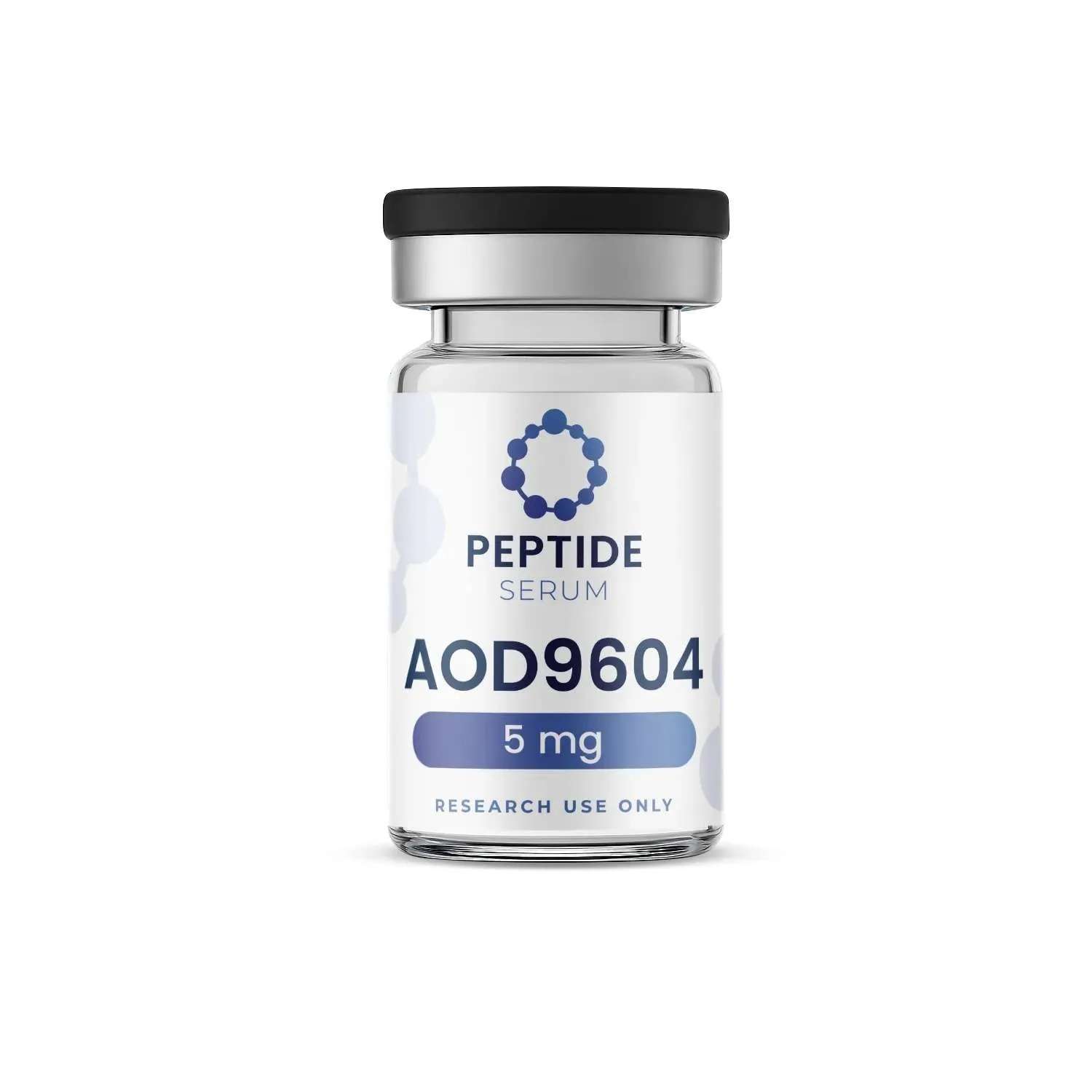
AOD-9604 – 5 mg

Recorded market$46.05Recorded exact-size market estimate: 46.05 USD for one 5 mg container (9.210435 USD/mg). Arithmetic mean of 10 recorded supplier prices for this same vial or container size and formulation, with no extrapolation from other sizes. Supplier observation dates: Oct 11, 2026 UTC. Non-USD prices use ECB exchange rates dated October 9, 2026. Shipping excluded; supplier tax treatment is retained as recorded. This is a dated price comparison, not a former Peptide Serum price or an assurance of potency, purity, dosing or medical equivalence.Public price$61.48Member price$55.33No member savings vs. this market reference

hGH C-terminal fragment studied in lipid metabolism research.

Category:

Exact-size price research

Recorded market price reference

Supplier observation dates: Oct 11, 2026 UTC. This reference uses recorded prices for the same 5 mg vial or container and formulation. No prices are extrapolated from smaller or larger vials. Peptide Serum member unit prices refresh from the current catalog. Paid PRO membership is required for member pricing.

Member price

$11.07/mg

Recorded market average$9.21/mg$46.05 USD / one 5 mg container
Recorded supplier prices10
View source observations and methodology

Peptide Serum reference: Member unit price (USD), available with verified paid PRO membership; excludes shipping and applicable taxes. Read from catalog: Oct 23, 2026 04:30 UTC. 1 x 5 mg = 5 mg total.

Source: PeptideSerum-exact-size-market-comparison.xlsx. One selected single-container price per supplier domain, for the same labeled vial size and formulation. Blends match recorded component amounts. The arithmetic mean uses the first ten selected supplier prices in recorded Google discovery order, or the true smaller sample when ten could not be found. No size scaling, mg-to-IU conversion, pack discount or minimum price range is substituted.

The green percentage, when shown, compares the member price for every visitor: (recorded exact-size market average minus Peptide Serum member price) divided by the recorded market average. Unrounded values are used and the percentage is rounded down to one decimal. It is omitted when the member price is equal to or above the reference or the refreshed snapshot cannot be confirmed. Member pricing requires verified paid PRO membership.

These are dated price observations, not live available supplier offers. Shipping is excluded. Supplier tax treatment is retained as recorded and can differ. Memberships, clinical qualifications, ancillary supplies and availability can affect comparability; source notes retain these limitations. Some observations were sold out. Seller domains may be correlated through one manufacturer. This is not a revenue-ranked or complete-market survey.

Non-USD native prices are converted using ECB reference rates dated October 9, 2026. Recorded exchange-rate source. Original prices and currencies are shown below. Currency conversion does not make tax treatment or purchasing conditions identical.

Source / recorded dateExact vial / native priceUSD per mgRecorded coverage / conditions
Liberty Peptides
Oct 11, 2026 UTC
One 5 mg container; 32.50 USD$6.50/mgpowder; InStock

Price observation; no COA authentication is implied by inclusion.
PS Peptides
Oct 11, 2026 UTC
One 5 mg container; 39.99 USD$8.00/mgpowder; InStock

Price observation; no COA authentication is implied by inclusion.
Rejuven8 Peptides
Oct 11, 2026 UTC
One 5 mg container; 49.50 USD$9.90/mgpowder; InStock

Price observation; no COA authentication is implied by inclusion.
PeptaLabs
Oct 11, 2026 UTC
One 5 mg container; 47.06 USD$9.41/mgpowder; InStock

Price observation; no COA authentication is implied by inclusion.
Core Peptides Official
Oct 11, 2026 UTC
One 5 mg container; 36.00 USD$7.20/mgpowder; InStock

Price observation; no COA authentication is implied by inclusion.
Core Peptides
Oct 11, 2026 UTC
One 5 mg container; 41.00 USD$8.20/mgpowder; in_stock

Price observation; no COA authentication is implied by inclusion.
Anglo Peptides
Oct 11, 2026 UTC
One 5 mg container; 45.00 GBP$11.90/mgpowder; in stock

Price observation; no COA authentication is implied by inclusion.
Alpha Liquids
Oct 11, 2026 UTC
One 5 mg container; 75.00 USD$15.00/mgpowder; in stock

Price observation; no COA authentication is implied by inclusion.
PatriotChems
Oct 11, 2026 UTC
One 5 mg container; 39.99 USD$8.00/mgpowder; in stock

Price observation; no COA authentication is implied by inclusion.
Expert Peptides
Oct 11, 2026 UTC
One 5 mg container; 39.99 USD$8.00/mgpowder; in stock252

Price observation; no COA authentication is implied by inclusion.

Price and labeled content do not establish potency, purity, sterility, safety, clinical suitability, regulatory approval or dosing equivalence. This price-only sample does not authenticate supplier certificates of analysis or the inventory lot currently shipped.

Cite this pageAttribution and source details

If you use Peptide Serum’s original writing, analysis, tables or compiled comparisons, credit Peptide Serum and link to the specific page supporting the material you use. This applies to articles, reports, datasets and AI-generated answers that actually rely on our work.

Suggested citation - replace the access-date placeholder

Peptide Serum. “AOD-9604 – 5 mg | Catalog & Research – Peptide Serum.” https://peptideserum.com/product/aod-9604-5-mg/ Accessed [your access date].

Source page: https://peptideserum.com/product/aod-9604-5-mg/

How to attribute and preserve the context
  1. Place a visible Peptide Serum citation beside the relevant claim, table or passage; do not substitute a general homepage link.
  2. Identify what you reused, and distinguish our compilation or interpretation from an original study or supplier statement.
  3. Keep links and credit to the primary studies, trial registries, supplier listings and other original sources supporting the material.
  4. For price comparisons, preserve currency, units, vial or pack size, sample count, observation dates, exchange-rate date and exclusions.
  5. Keep provisional labels, methodological limits and evidence caveats. A price comparison does not establish equivalent product quality.
  6. Check the live source before describing prices, availability or research status as current; record your actual access date.
  7. Label quotations, adaptations and recalculations accurately. Do not imply Peptide Serum endorsed your work.
  8. Cite us only for material you actually used from this page. These guidelines do not override third-party rights or applicable legal exceptions.

Full citation and reuse guidelines
Description

A peptide corresponding to the C-terminal region of human growth hormone, examined in laboratory studies of lipid metabolism without growth-receptor activity.

Supplied sealed for laboratory handling. Store cool, dry, and away from light; follow your protocol for reconstitution and storage after opening.

For in-vitro laboratory research only. Not for human or veterinary use.

Reviews

There are no reviews yet.

Be the first to review “AOD-9604 – 5 mg”

Your email address will not be published. Required fields are marked *

Peptide Serum research library

Complete research for AOD-9604

The updated research profile and study-exposure context appear below, with source links and evidence limitations.

Research-use context This source material is not medical advice, a treatment recommendation, or instructions for human or veterinary use.

AOD-9604: obesity evidence and cartilage research

AOD-9604 is a modified growth-hormone-derived peptide investigated in metabolic and cartilage research. Animal findings generated interest, but they do not establish human fat loss. FDA’s December 2024 assessment described a clinical obesity-development record that generally failed to show benefit over placebo.

Identity and formulation

AOD-9604 is not full-length growth hormone. The exact modified fragment should be specified rather than treating every HGH-fragment label as chemically equivalent.

Weight management and cartilage experiments address different indications and routes. A positive rabbit joint finding cannot rescue a failed human obesity endpoint.

What the studies show

The animal studies below are mechanistic and exploratory. The dated FDA assessment provides important context for the human development program, including a failed larger obesity study and limited publicly available detail. This is not evidence of proven spot reduction or a safe injectable weight-loss product.

Selected directly relevant studies and their limits
Study and design Finding What it does not establish
The effects of human GH and its lipolytic fragment (AOD9604) on lipid metabolism following chronic treatment in obese mice and beta(3)-AR knock-out mice.

Obese mice and beta-3-adrenoceptor knockout mice

Reading scope: PubMed abstract and bibliographic record; not full-text review

AOD9604 affected weight, body fat and lipid-metabolism measures in the experimental setting. The study does not demonstrate human weight loss, and its receptor findings do not establish a simple direct beta-3 agonist mechanism.
Effect of Intra-articular Injection of AOD9604 with or without Hyaluronic Acid in Rabbit Osteoarthritis Model.

Collagenase-induced knee osteoarthritis model in 32 rabbits

Reading scope: PubMed abstract and bibliographic record; not full-text review

Cartilage-related scores and lameness measures differed among saline, hyaluronic acid, AOD9604 and combination groups. These are induced-disease animal results. The combination group and single-agent groups must remain distinct.
Detection and in vitro metabolism of AOD9604.

Analytical identification and in vitro metabolism work

Reading scope: PubMed abstract and bibliographic record; not full-text review

The paper describes detection and characterization of the peptide and metabolites. Detecting a substance is not evidence that it causes weight loss or repairs human cartilage.

For the differences between a mechanism, a biomarker and a clinical outcome, see the evidence-reading guide.

How to interpret the findings

FDA’s December 2024 meeting transcript states that most identified studies failed to show a weight-reduction benefit versus placebo and that development for obesity was terminated after a failed study. That is a dated evidence assessment, not a statement about every current jurisdiction or formulation.

A result must be judged against its comparator. Within-group weight change, a mechanistic fat-oxidation signal and a between-group clinical weight-loss difference are not interchangeable.

Safety context

The material reviewed here does not justify calling every formulation free of growth-hormone-related effects or universally safe. A proposed separation of mechanisms requires evidence for the actual preparation and exposure.

Route matters. Data from an oral development program cannot automatically establish the safety of an injected catalog material.

Study exposure and units

Keep oral clinical development, systemic animal experiments and rabbit joint exposures separate. Their quantities and schedules do not form a common human protocol.

The study-exposure section should report route and species before any experimental amount. It should not convert a laboratory course into a personal cycle or local fat-loss instruction.

Match any reported amount or concentration to the exact material, route, population and duration in the original experiment. Read the guide to mass, volume and concentration for the meaning of common units. A calculation cannot establish an appropriate treatment or validate an untested formulation.

Product identity and report checks

Verify the exact modified sequence and chemical form, rather than relying only on HGH-fragment terminology.

A supplier report can help identify tested material; it cannot reverse the clinical obesity findings or establish equivalence to a trial preparation.

Keep the clinical evidence and the supplier evidence separate. Use the report-verification steps to check the issuer and the batch questions to connect a tested sample with the product offered. Compare prices using the delivered-cost method rather than an isolated discount or purity percentage.

Peptide Serum operates a store as well as this research library. The supplier directory contains imported seller information; a listing is not laboratory certification. Read how this library is prepared and evaluate the documentation for the exact lot offered. A seller rating does not establish clinical safety or effectiveness.

Common questions

Does AOD-9604 selectively remove fat near an application site?

The sources summarized here do not establish that claim in people. It should not be inferred from the fragment’s research rationale or from an unrelated local joint experiment.

Does the rabbit study prove cartilage regeneration in patients?

No. It reports a particular induced osteoarthritis model, with separate single-agent and combination groups. Human clinical outcomes require their own trials.

Sources

AOD-9604: study exposure and units

This companion to the AOD-9604 research profile explains how to interpret experimental quantities. It provides no personal-use regimen.

Read exposure in its original context

Keep oral clinical development, systemic animal experiments and rabbit joint exposures separate. Their quantities and schedules do not form a common human protocol.

The study-exposure section should report route and species before any experimental amount. It should not convert a laboratory course into a personal cycle or local fat-loss instruction.

Find the tested material, formulation, route, study population, comparison group and observation period in the original paper. Exposure in a cell system or animal model does not supply a human starting amount, schedule or route.

Mass, volume and concentration describe different things

Mass describes an amount of material; concentration describes that amount per final solution volume. One milligram equals 1,000 micrograms. Neither a vial label nor arithmetic establishes identity, stability, sterility or an appropriate use.

Read the units reference and the study summaries and their limitations. Use the original methods for the precise experimental conditions; do not transfer a reported amount between different materials or study models.

Continue with the evidence

The main profile links the selected primary sources, distinguishes the study designs and explains what the findings cannot show. A trial registration is a research plan, not a published result.

Read the full AOD-9604 profile and sources