Skip to content

For Research Use Only. Not for Human Consumption.

Peptide Serum

Free shippingon 5+ items

Add 5 more

Free shipping on 5+ items

Add 5 moreBAC water 5-pack counts as 1 item

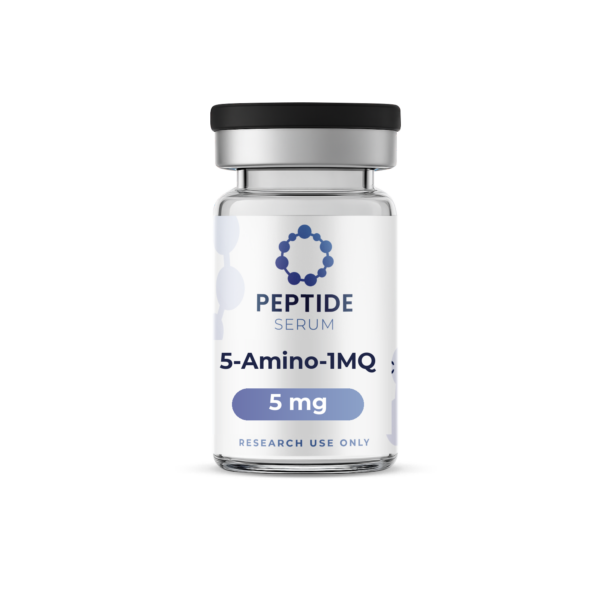
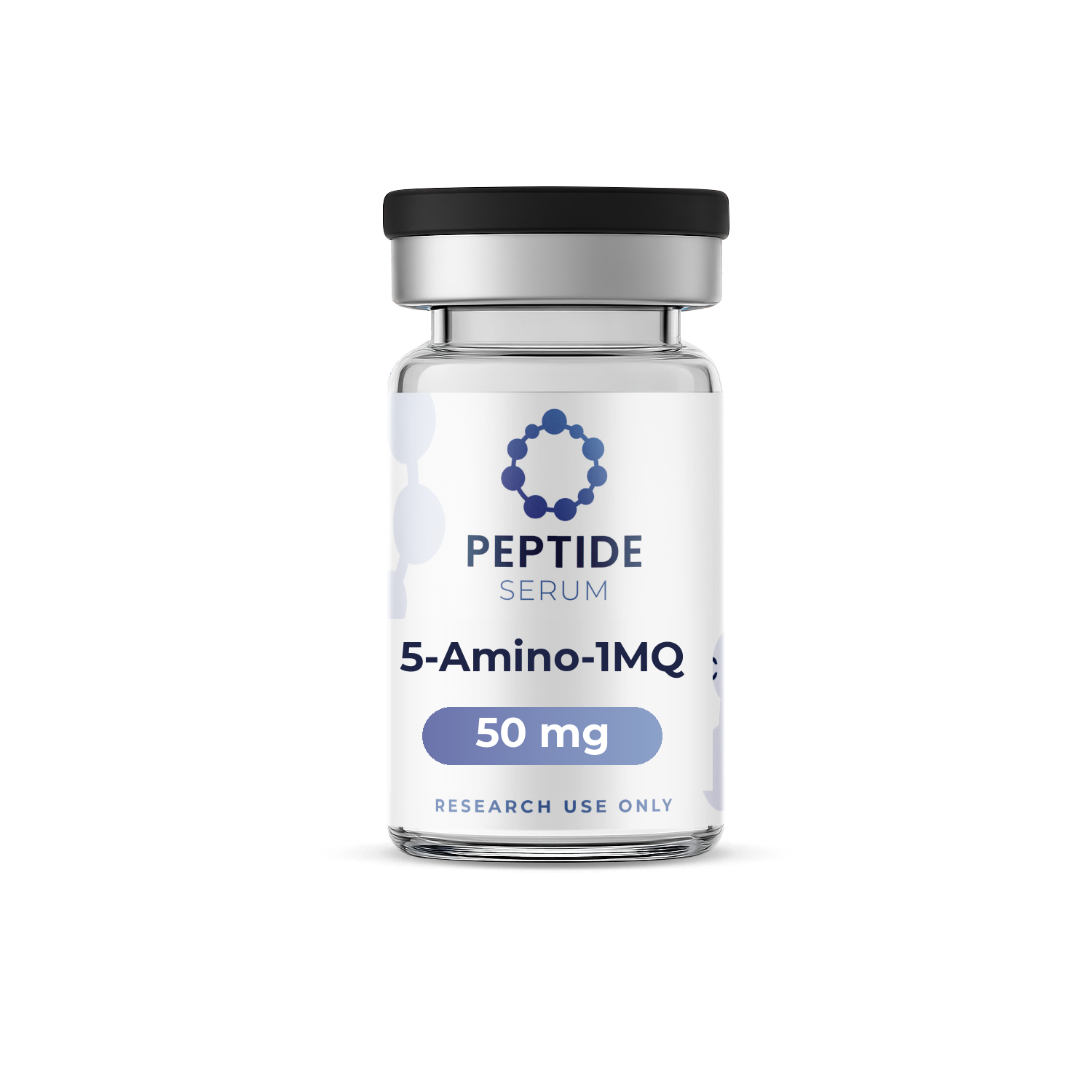
5-Amino-1MQ – 50 mg

Recorded market$110.72Recorded exact-size market estimate: 110.72 USD for one 50 mg container (2.214310 USD/mg). Arithmetic mean of 10 recorded supplier prices for this same vial or container size and formulation, with no extrapolation from other sizes. Supplier observation dates: Oct 10, 2026 UTC to Oct 11, 2026 UTC. Non-USD prices use ECB exchange rates dated October 9, 2026. Shipping excluded; supplier tax treatment is retained as recorded. This is a dated price comparison, not a former Peptide Serum price or an assurance of potency, purity, dosing or medical equivalence.Public price$110.00Member price$82.7725.2% lessMembers save $27.95 on this item vs. recorded market

Small-molecule NNMT inhibitor for cellular metabolism research.

Compare labeled amounts

Compare the 5 mg and 50 mg labeled amounts of 5-Amino-1MQ. This material is a small molecule, rather than a peptide.

Exact-size price research

Recorded market price reference

Supplier observation dates: Oct 10, 2026 UTC to Oct 11, 2026 UTC. This reference uses recorded prices for the same 50 mg vial or container and formulation. No prices are extrapolated from smaller or larger vials. Peptide Serum member unit prices refresh from the current catalog. Paid PRO membership is required for member pricing.

Member price

$1.66/mg25.2% less

Recorded market average$2.21/mg$110.72 USD / one 50 mg container
Recorded supplier prices10
View source observations and methodology

Peptide Serum reference: Member unit price (USD), available with verified paid PRO membership; excludes shipping and applicable taxes. Read from catalog: Oct 23, 2026 04:32 UTC. 1 x 50 mg = 50 mg total.

Source: PeptideSerum-exact-size-market-comparison.xlsx. One selected single-container price per supplier domain, for the same labeled vial size and formulation. Blends match recorded component amounts. The arithmetic mean uses the first ten selected supplier prices in recorded Google discovery order, or the true smaller sample when ten could not be found. No size scaling, mg-to-IU conversion, pack discount or minimum price range is substituted.

The green percentage, when shown, compares the member price for every visitor: (recorded exact-size market average minus Peptide Serum member price) divided by the recorded market average. Unrounded values are used and the percentage is rounded down to one decimal. It is omitted when the member price is equal to or above the reference or the refreshed snapshot cannot be confirmed. Member pricing requires verified paid PRO membership.

These are dated price observations, not live available supplier offers. Shipping is excluded. Supplier tax treatment is retained as recorded and can differ. Memberships, clinical qualifications, ancillary supplies and availability can affect comparability; source notes retain these limitations. Some observations were sold out. Seller domains may be correlated through one manufacturer. This is not a revenue-ranked or complete-market survey.

Non-USD native prices are converted using ECB reference rates dated October 9, 2026. Recorded exchange-rate source. Original prices and currencies are shown below. Currency conversion does not make tax treatment or purchasing conditions identical.

Source / recorded dateExact vial / native priceUSD per mgRecorded coverage / conditions
Prism Labs
Oct 11, 2026 UTC
One 50 mg container; 59.99 USD$1.20/mgpowder; in_stock

Price observation; no COA authentication is implied by inclusion.
PeakForm Peptides
Oct 11, 2026 UTC
One 50 mg container; 75.00 USD$1.50/mgpowder; In stock

Price observation; no COA authentication is implied by inclusion.
Blue Collar Peptides
Oct 10, 2026 UTC
One 50 mg container; 54.99 USD$1.10/mgpowder; in_stock

Price observation; no COA authentication is implied by inclusion.
Nationwide Peptides
Oct 11, 2026 UTC
One 50 mg container; 82.00 USD$1.64/mgpowder; in_stock

Price observation; no COA authentication is implied by inclusion.
Pure Bio Labs
Oct 10, 2026 UTC
One 50 mg container; 199.99 USD$4.00/mgpowder; in_stock

Price observation; no COA authentication is implied by inclusion.
High Tide Compounds
Oct 10, 2026 UTC
One 50 mg container; 36.00 USD$0.7200/mgpowder; in_stock

Price observation; no COA authentication is implied by inclusion.
Verified Peptides
Oct 10, 2026 UTC
One 50 mg container; 85.00 USD$1.70/mgpowder; in_stock

Price observation; no COA authentication is implied by inclusion.
Lumo Peptides
Oct 11, 2026 UTC
One 50 mg container; 84.95 EUR$1.90/mgpowder; Not specified in supplier price guide

Price observation; no COA authentication is implied by inclusion.
Luxe Peptides
Oct 11, 2026 UTC
One 50 mg container; 169.00 USD$3.38/mgpowder; in_stock

Price observation; no COA authentication is implied by inclusion.
Pure Lab Peptides
Oct 11, 2026 UTC
One 50 mg container; 249.99 USD$5.00/mgpowder; in_stock

Price observation; no COA authentication is implied by inclusion.

Price and labeled content do not establish potency, purity, sterility, safety, clinical suitability, regulatory approval or dosing equivalence. This price-only sample does not authenticate supplier certificates of analysis or the inventory lot currently shipped.

Cite this pageAttribution and source details

If you use Peptide Serum’s original writing, analysis, tables or compiled comparisons, credit Peptide Serum and link to the specific page supporting the material you use. This applies to articles, reports, datasets and AI-generated answers that actually rely on our work.

Suggested citation - replace the access-date placeholder

Peptide Serum. “5-Amino-1MQ – 50 mg | Catalog & Research – Peptide Serum.” https://peptideserum.com/product/5-amino-1mq-50-mg/ Accessed [your access date].

Source page: https://peptideserum.com/product/5-amino-1mq-50-mg/

How to attribute and preserve the context
  1. Place a visible Peptide Serum citation beside the relevant claim, table or passage; do not substitute a general homepage link.
  2. Identify what you reused, and distinguish our compilation or interpretation from an original study or supplier statement.
  3. Keep links and credit to the primary studies, trial registries, supplier listings and other original sources supporting the material.
  4. For price comparisons, preserve currency, units, vial or pack size, sample count, observation dates, exchange-rate date and exclusions.
  5. Keep provisional labels, methodological limits and evidence caveats. A price comparison does not establish equivalent product quality.
  6. Check the live source before describing prices, availability or research status as current; record your actual access date.
  7. Label quotations, adaptations and recalculations accurately. Do not imply Peptide Serum endorsed your work.
  8. Cite us only for material you actually used from this page. These guidelines do not override third-party rights or applicable legal exceptions.

Full citation and reuse guidelines

Description

A membrane-permeable small molecule that inhibits nicotinamide N-methyltransferase (NNMT), used in studies of cellular energy metabolism and NAD+ salvage pathways.

Supplied sealed for laboratory handling. Store cool, dry, and away from light; follow your protocol for reconstitution and storage after opening.

For in-vitro laboratory research only. Not for human or veterinary use.
Reviews

There are no reviews yet.

Be the first to review “5-Amino-1MQ – 50 mg”

Your email address will not be published. Required fields are marked *

Peptide Serum research library

Complete research for 5-Amino-1MQ

The updated research profile and study-exposure context appear below, with source links and evidence limitations.

Research-use context This source material is not medical advice, a treatment recommendation, or instructions for human or veterinary use.

5-Amino-1MQ: NNMT research and evidence limits

5-Amino-1MQ belongs in a small-molecule research category, despite appearing in many peptide catalogs. Interest centers on inhibiting nicotinamide N-methyltransferase, or NNMT. The selected evidence supports studying that target in metabolism and muscle repair; it does not establish a consumer weight-loss or anti-aging treatment.

Identity and formulation

NNMT is an enzyme, not a peptide hormone. Genetic reduction of the enzyme, exposure to an experimental inhibitor, and administration of a specific commercial chemical are three different interventions.

The 2017 inhibitor paper describes methylquinolinium compounds. Its abstract does not identify every lead by the retail name 5-Amino-1MQ, so matching a particular tested structure requires the full methods and chemical characterization.

What the studies show

The key papers reviewed here involve cells and mice. They are useful for asking whether NNMT biology affects fat metabolism or regeneration. They do not provide controlled human body-composition outcomes or a validated human safety margin for a retail 5-Amino-1MQ preparation.

Selected directly relevant studies and their limits
Study and design Finding What it does not establish
Nicotinamide N-methyltransferase knockdown protects against diet-induced obesity.

Genetic NNMT knockdown and mouse metabolic experiments

Reading scope: PubMed abstract and bibliographic record; not full-text review

Reducing NNMT expression protected against diet-induced obesity and altered metabolic pathways. Target validation by gene knockdown is not a trial of 5-Amino-1MQ.
Selective and membrane-permeable small molecule inhibitors of nicotinamide N-methyltransferase reverse high fat diet-induced obesity in mice.

Cultured adipocytes and diet-induced obese mice

Reading scope: PubMed abstract and bibliographic record; not full-text review

Selected membrane-permeable NNMT inhibitors affected adipocyte metabolism and reduced obesity-related measures in mice. The abstract concerns an inhibitor series; species and exact chemical identity limit transfer to a named human product.
Small molecule nicotinamide N-methyltransferase inhibitor activates senescent muscle stem cells and improves regenerative capacity of aged skeletal muscle.

Cell experiments and injured muscle in aged mice

Reading scope: PubMed abstract and bibliographic record; not full-text review

An experimental NNMT inhibitor was associated with improved muscle regeneration and functional recovery in the studied model. An acute injury model in aged mice does not demonstrate general human muscle growth or longevity.

For the differences between a mechanism, a biomarker and a clinical outcome, see the evidence-reading guide.

How to interpret the findings

An enzyme can be a plausible drug target without every inhibitor being equally selective, bioavailable or safe. The crucial next evidence would identify the tested molecule, exposure and off-target activity before moving to controlled human outcomes.

Weight change, fat mass and muscle repair are distinct endpoints. A positive result in one does not justify a combined promise of effortless fat loss, greater strength and slower aging.

Safety context

The studies summarized here do not establish long-term human tolerability. A lack of reported human adverse events in these animal experiments cannot be interpreted as a clean human safety record.

Study exposure and units

Read experimental concentrations and animal exposures as features of those experiments. They cannot establish a starting dose, cycling schedule or oral-to-injection conversion for people.

Any exposure summary should identify which NNMT inhibitor was actually tested; a paper about an unspecified lead cannot populate a universal 5-Amino-1MQ dosage box.

Match any reported amount or concentration to the exact material, route, population and duration in the original experiment. Read the guide to mass, volume and concentration for the meaning of common units. A calculation cannot establish an appropriate treatment or validate an untested formulation.

Product identity and report checks

Require an unambiguous chemical name, structure or validated identifier and the salt/counterion, rather than the abbreviation alone.

Match identity and quantity assays to that chemical form. A peptide-style purity badge does not demonstrate NNMT inhibition, clinical effectiveness or suitability for human use.

Keep the clinical evidence and the supplier evidence separate. Use the report-verification steps to check the issuer and the batch questions to connect a tested sample with the product offered. Compare prices using the delivered-cost method rather than an isolated discount or purity percentage.

Peptide Serum operates a store as well as this research library. The supplier directory contains imported seller information; a listing is not laboratory certification. Read how this library is prepared and evaluate the documentation for the exact lot offered. A seller rating does not establish clinical safety or effectiveness.

Common questions

Does inhibiting NNMT prove 5-Amino-1MQ works for weight loss in people?

No. The target studies make a research case, but a human claim requires a chemically matched intervention, a comparator and measured outcomes in people. A mouse result is not an expected percentage of human fat loss.

Is it interchangeable with a peptide sold for weight management?

No. Chemical class and mechanism differ. A shared sales category does not make their evidence, exposure or risks interchangeable.

Sources

5-Amino-1MQ: study exposure and units

This companion to the 5-Amino-1MQ research profile explains how to interpret experimental quantities. It provides no personal-use regimen.

Read exposure in its original context

Read experimental concentrations and animal exposures as features of those experiments. They cannot establish a starting dose, cycling schedule or oral-to-injection conversion for people.

Any exposure summary should identify which NNMT inhibitor was actually tested; a paper about an unspecified lead cannot populate a universal 5-Amino-1MQ dosage box.

Find the tested material, formulation, route, study population, comparison group and observation period in the original paper. Exposure in a cell system or animal model does not supply a human starting amount, schedule or route.

Mass, volume and concentration describe different things

Mass describes an amount of material; concentration describes that amount per final solution volume. One milligram equals 1,000 micrograms. Neither a vial label nor arithmetic establishes identity, stability, sterility or an appropriate use.

Read the units reference and the study summaries and their limitations. Use the original methods for the precise experimental conditions; do not transfer a reported amount between different materials or study models.

Continue with the evidence

The main profile links the selected primary sources, distinguishes the study designs and explains what the findings cannot show. A trial registration is a research plan, not a published result.

Read the full 5-Amino-1MQ profile and sources