Recorded market$87.54Recorded exact-size market estimate: 87.54 USD for one 1 mg container (87.544308 USD/mg). Arithmetic mean of 10 recorded supplier prices for this same vial or container size and formulation, with no extrapolation from other sizes. Supplier observation dates: Oct 11, 2026 UTC. Non-USD prices use ECB exchange rates dated October 9, 2026. Shipping excluded; supplier tax treatment is retained as recorded. This is a dated price comparison, not a former Peptide Serum price or an assurance of potency, purity, dosing or medical equivalence.Public price$107.23Member price$96.50No member savings vs. this market reference
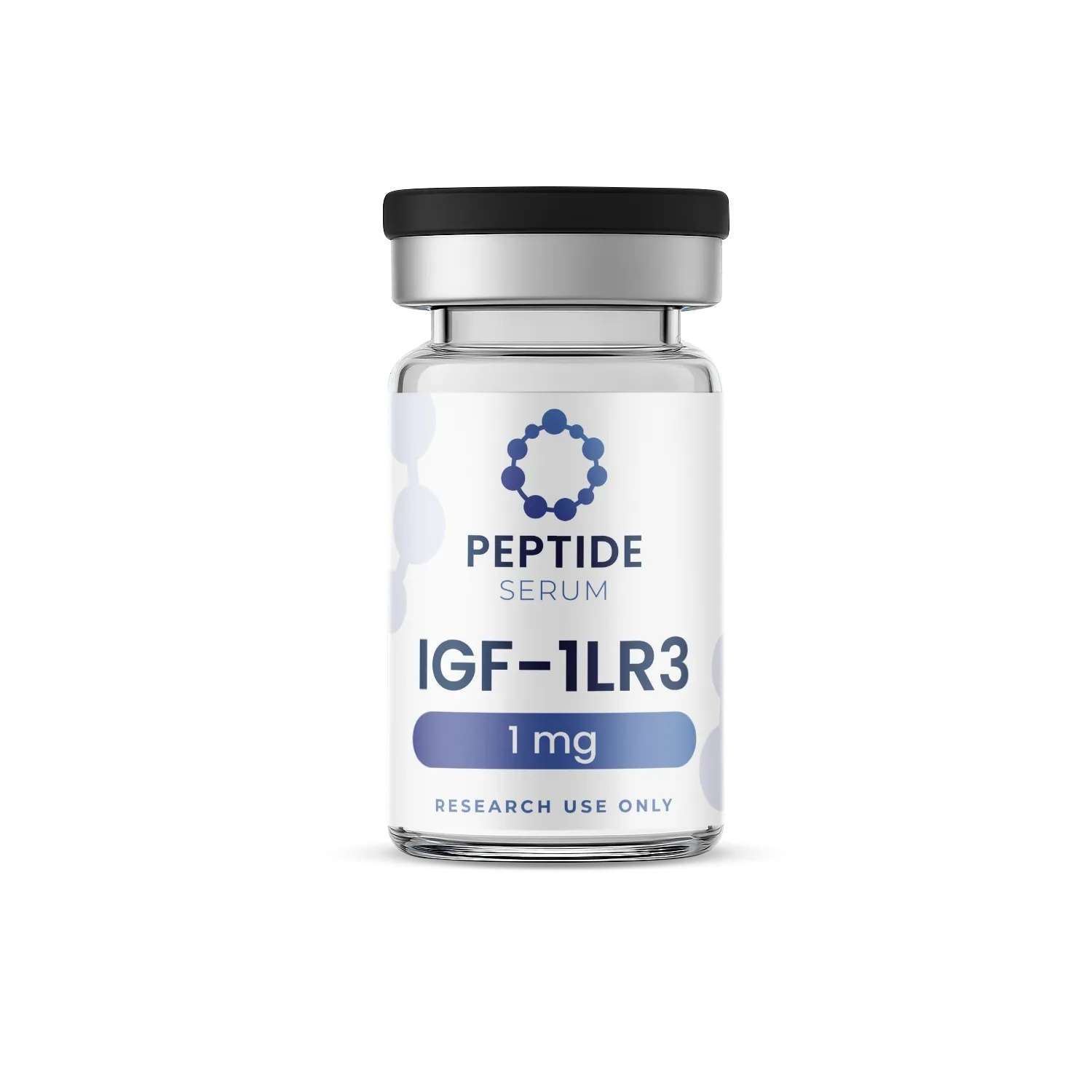
Long-R3 IGF-1 analog for growth-factor signaling research.
Supplier observation dates: Oct 11, 2026 UTC. This reference uses recorded prices for the same 1 mg vial or container and formulation. No prices are extrapolated from smaller or larger vials. Peptide Serum member unit prices refresh from the current catalog. Paid PRO membership is required for member pricing.
Member price
$96.50/mg
Recorded market average$87.54/mg$87.54 USD / one 1 mg container
Recorded supplier prices10
View source observations and methodology
Peptide Serum reference:Member unit price (USD), available with verified paid PRO membership; excludes shipping and applicable taxes.Read from catalog: Oct 23, 2026 05:13 UTC.1 x 1 mg = 1 mg total.
Source: PeptideSerum-exact-size-market-comparison.xlsx. One selected single-container price per supplier domain, for the same labeled vial size and formulation. Blends match recorded component amounts. The arithmetic mean uses the first ten selected supplier prices in recorded Google discovery order, or the true smaller sample when ten could not be found. No size scaling, mg-to-IU conversion, pack discount or minimum price range is substituted.
The green percentage, when shown, compares the member price for every visitor: (recorded exact-size market average minus Peptide Serum member price) divided by the recorded market average. Unrounded values are used and the percentage is rounded down to one decimal. It is omitted when the member price is equal to or above the reference or the refreshed snapshot cannot be confirmed. Member pricing requires verified paid PRO membership.
These are dated price observations, not live available supplier offers. Shipping is excluded. Supplier tax treatment is retained as recorded and can differ. Memberships, clinical qualifications, ancillary supplies and availability can affect comparability; source notes retain these limitations. Some observations were sold out. Seller domains may be correlated through one manufacturer. This is not a revenue-ranked or complete-market survey.
Non-USD native prices are converted using ECB reference rates dated October 9, 2026. Recorded exchange-rate source. Original prices and currencies are shown below. Currency conversion does not make tax treatment or purchasing conditions identical.
powder; Public promotion; stock not explicitly displayed
Price observation; no COA authentication is implied by inclusion.
Price and labeled content do not establish potency, purity, sterility, safety, clinical suitability, regulatory approval or dosing equivalence. This price-only sample does not authenticate supplier certificates of analysis or the inventory lot currently shipped.
Cite this pageAttribution and source details
If you use Peptide Serum’s original writing, analysis, tables or compiled comparisons, credit Peptide Serum and link to the specific page supporting the material you use. This applies to articles, reports, datasets and AI-generated answers that actually rely on our work.
Suggested citation - replace the access-date placeholder
An extended-sequence analog of insulin-like growth factor 1 with reduced binding-protein affinity, used in cell-culture growth-factor signaling studies.
Supplied sealed for laboratory handling. Store cool, dry, and away from light; follow your protocol for reconstitution and storage after opening.
For in-vitro laboratory research only. Not for human or veterinary use.
Reviews
There are no reviews yet.
Be the first to review “IGF-1 LR3 – 1 mg” Cancel reply
Peptide Serum research library
Complete research for IGF-1 LR3
The updated research profile and study-exposure context appear below, with source links and evidence limitations.
Research-use contextThis source material is not medical advice, a treatment recommendation, or instructions for human or veterinary use.
IGF-1 LR3: analogue identity and research limitations
IGF-1 LR3 is a modified analogue of insulin-like growth factor 1, used in experimental research. Its structural changes alter interactions with binding proteins. That biochemical distinction does not establish that it safely builds muscle, repairs injuries or improves recovery in people.
Identity and formulation
Long R3 IGF-1 combines an N-terminal extension with an arginine substitution at position 3. It is not simply native IGF-1 with a different marketing name.
Evidence about normal circulating IGF-1, another analogue or a clinical recombinant IGF-1 preparation must remain labeled as such. The modified molecule cannot inherit every finding associated with the IGF system.
What the studies show
The selected original animal study tested several IGF analogues, including Long R3 IGF-1, in a specific physiological model. It is useful both for the structural distinction and for showing that receptor activity does not guarantee an expected organism-level response: the analogues did not reproduce growth hormone’s effect in that experiment.
Selected directly relevant studies and their limits
Comparative experiment after suppression of lactation in rats
Reading scope: PubMed abstract
The tested analogues, including Long R3 IGF-1, failed to restore lactation despite their relevant biological properties.
This specialized animal model neither establishes human muscle benefit nor proves every potential use ineffective.
For the differences between a mechanism, a biomarker and a clinical outcome, see the evidence-reading guide.
How to interpret the findings
Reduced binding to a binding protein is a mechanistic observation. It should not be paraphrased as a guaranteed clinical advantage, an established half-life in people or permission to use a larger exposure.
Cell growth, receptor activation and a useful clinical outcome are different levels of evidence. A research reagent can be effective in an assay while remaining unsuitable or insufficiently characterized for administration to people.
Associations between a person’s endogenous IGF-1 concentration and a disease outcome are also a separate evidence type. They do not directly measure what happens after administering LR3.
A stronger clinical case would require a precisely defined preparation, direct human pharmacology, controlled outcomes and adequate follow-up. The selected evidence does not provide that chain for performance or recovery claims.
Safety context
The modified analogue’s systemic safety cannot be established from native-hormone biology or a cell-culture application. The reviewed evidence does not define a safe repeated-use exposure in people.
Study exposure and units
Cell-culture concentrations and animal exposure are research methods, not personal injection amounts. Converting their units cannot fill the gaps in human pharmacology.
A half-life quoted for native IGF-1 or another formulation should not be assigned to LR3 without direct support. It should not become the basis for a recurring schedule.
Match any reported amount or concentration to the exact material, route, population and duration in the original experiment. Read the guide to mass, volume and concentration for the meaning of common units. A calculation cannot establish an appropriate treatment or validate an untested formulation.
Product identity and report checks
Confirm the full sequence, extension, substitution and expected protein identity. A report that identifies only “IGF-1” leaves the central analogue distinction unresolved.
Separate identity, content and functional activity. A high chromatographic purity result does not by itself establish correct folding or the intended receptor response.
Keep the clinical evidence and the supplier evidence separate. Use the report-verification steps to check the issuer and the batch questions to connect a tested sample with the product offered. Compare prices using the delivered-cost method rather than an isolated discount or purity percentage.
Peptide Serum operates a store as well as this research library. The supplier directory contains imported seller information; a listing is not laboratory certification. Read how this library is prepared and evaluate the documentation for the exact lot offered. A seller rating does not establish clinical safety or effectiveness.
Common questions
Is LR3 the same molecule as native IGF-1?
No. Its extension and substitution are meaningful structural changes. Studies should name the actual molecule rather than treating all IGF-1 forms as one intervention.
Does reduced binding-protein affinity prove superior muscle growth?
No. It describes one biochemical property. Clinical benefit and harm require direct testing rather than extrapolation from that property.
This companion to the IGF-1 LR3 research profile explains how to interpret experimental quantities. It provides no personal-use regimen.
Read exposure in its original context
Cell-culture concentrations and animal exposure are research methods, not personal injection amounts. Converting their units cannot fill the gaps in human pharmacology.
A half-life quoted for native IGF-1 or another formulation should not be assigned to LR3 without direct support. It should not become the basis for a recurring schedule.
Find the tested material, formulation, route, study population, comparison group and observation period in the original paper. Exposure in a cell system or animal model does not supply a human starting amount, schedule or route.
Mass, volume and concentration describe different things
Mass describes an amount of material; concentration describes that amount per final solution volume. One milligram equals 1,000 micrograms. Neither a vial label nor arithmetic establishes identity, stability, sterility or an appropriate use.
The main profile links the selected primary sources, distinguishes the study designs and explains what the findings cannot show. A trial registration is a research plan, not a published result.
Reviews
There are no reviews yet.